Archival Digital
Asset Container
An open specification for packaging, organizing, and preserving digital assets with complete provenance, integrity, and accessibility.
Why ADAC?
Digital assets are often scattered across incompatible formats, lacking metadata, and vulnerable to corruption. ADAC provides a unified container format that ensures long-term preservation and instant accessibility.
Unified Container
Single file format packaging assets with metadata, manifests, and checksums. Standard ZIP-based — openable with any ZIP utility, no proprietary reader required.
Integrity Verification
SHA-256 checksums stored in every container detect corruption or unauthorized alteration of assets — master file checksums serve as an immutability seal.
Provenance Tracking
Complete audit trail of creation, modification, and transfer history.
Living Archive
Designed to be opened, enriched, and re-saved throughout its lifetime — metadata refined, regions annotated, derivatives regenerated — without ever disturbing the original master.
{
  "adacVersion": "1.0",
  "id": "550e8400-e29b-41d4-a716-446655440000",
  "createdOn": "2025-01-15T10:30:00Z",
  "createdBy": "GeneaScan v1.0",
  "masters": [
    {
      "id": "master-001",
      "file": "master/master_0001.tif",
      "regions": "regions/master-001.regions.json",
      "edits": "edits/master-001.edits.json"
    }
  ],
  "derivatives": [
    {
      "id": "preview-001",
      "file": "derivatives/deriv_0001.jpg",
      "sourceMasterId": "master-001",
      "purpose": "web-preview"
    }
  ],
  "metadata": {
    "core": "metadata/core.json",
    "profiles": [
      "metadata/profiles/legal.json"
    ],
    "provenanceLog": "provenance/log.json",
    "checksums": "provenance/checksums.json"
  }
}
A Four-Layer Architecture
Each layer is independently optional. A Minimal-conformant container requires only Layer 1.
manifest.json, core.json, master/, derivatives/ — identity, descriptive metadata, and artifact files.
provenance/log.json, checksums.json — chronological event history and SHA-256 fixity for every file.
regions/, edits/, metadata/xmp/ — region annotations, non-destructive edit pipelines, and XMP sidecars.
metadata/profiles/*.json — ADAC-Genealogy, ADAC-Legal, and custom domain extensions via linked entities.
Technical Specifications
Comprehensive documentation for implementing ADAC-compliant containers and tools.
Container Structure
Standard ZIP-based archival package with a defined layout: master/, derivatives/, metadata/, regions/, edits/, and provenance/ — all governed by a root manifest.json.
.adac extension. Any standard ZIP utility — 7-Zip, WinRAR, macOS Archive Utility, Windows Explorer — can open and inspect them without special software.
Masters & Derivatives
Every container separates the original artifact from its working copies. Masters are stored uncompressed and are immutable once ingested — their SHA-256 checksum is their identity. Derivatives (previews, thumbnails, print proofs, web-optimized versions) are regenerable from the master and are not considered archivally significant.
View SpecFixity & Integrity
SHA-256 checksums are recomputed on every save and stored in provenance/checksums.json. Master file checksums act as an immutability seal — a changed master hash signals tampering or corruption.
Metadata Standards
Core metadata aligns with Dublin Core for descriptive fields and PREMIS for preservation context. Supports XMP sidecars for interoperability with Adobe tools, ExifTool, and the broader imaging ecosystem.
View SpecRegion Annotations
Bounded areas within a master — pixel rectangles on images, time segments in audio/video, or 3D coordinate ranges — each carrying a linkedEntities dictionary for namespaced domain data.
Edit Pipelines
Non-destructive editing operations (crop, rotate, deskew, levels) recorded as ordered JSON pipelines in edits/. The original master is never modified — transformations are replayed on demand to produce derivatives.
Provenance Log
Chronological event history in provenance/log.json recording every significant action — scan, import, edit, derivative creation, export — from first capture through the present.
Profile Extensions
Additive domain-specific metadata files in metadata/profiles/. Profiles never modify core structures — non-profile-aware readers ignore them entirely. Multiple profiles coexist in the same container.
Security Model
Encryption descriptor model for pre-encrypted content — ADAC stores opaque ciphertext and records the algorithm and key reference. Includes path traversal and ZIP bomb mitigations for safe extraction.
View SpecAPI Reference
RESTful API for container creation, validation, fixity verification, and extraction — enabling integration with existing document management systems and archival workflows.
View SpecDomain Profile Extensions
ADAC's additive profile mechanism extends the base format with domain-specific metadata — without modifying any core structures. Any ADAC reader can open a profiled container.
ADAC-Genealogy 1.0
Designed for digitized genealogical records — census pages, vital records, church registers, land deeds, and immigration manifests. Embeds structured source citations, GPS evidence analysis, and per-region person annotations directly in the container.
genealogy:person), transcriptions with confidence scores, and legibility assessments
ADAC-Legal 1.0
Designed for legal documents — exhibits, pleadings, contracts, depositions, court orders, and affidavits. Embeds case references, Bates numbering, chain-of-custody records, and per-region redaction metadata directly in the container.
privileged, sealed), and retention policies with litigation hold
legal:exhibit) and redaction metadata (legal:redaction) with legal authority
Multi-Profile Coexistence
A single container MAY carry multiple profiles simultaneously. A probate document could hold both an ADAC-Legal profile (case reference, custody chain, confidentiality level) and an ADAC-Genealogy profile (person annotations, transcriptions, GPS evidence) — with linked entity keys using distinct namespaces (legal:exhibit vs. genealogy:person) to avoid conflict.
Industry Use Cases
ADAC is designed to serve diverse industries requiring robust digital asset management and preservation.

Institutional Digital Preservation
The founding use case for ADAC. Museums, national archives, university libraries, and cultural heritage institutions can use ADAC to ingest, describe, and preserve digitized collections — manuscripts, photographs, maps, audio recordings, and artifacts — with full provenance and fixity guarantees that span decades.
- Self-describing containers with Dublin Core and PREMIS-aligned metadata
- SHA-256 fixity verification ensures bit-level integrity over long-term storage
- Standard ZIP-based format — no vendor lock-in, readable by any utility in perpetuity
- Chronological provenance log for complete chain of custody from acquisition onward
Genealogical Record Preservation
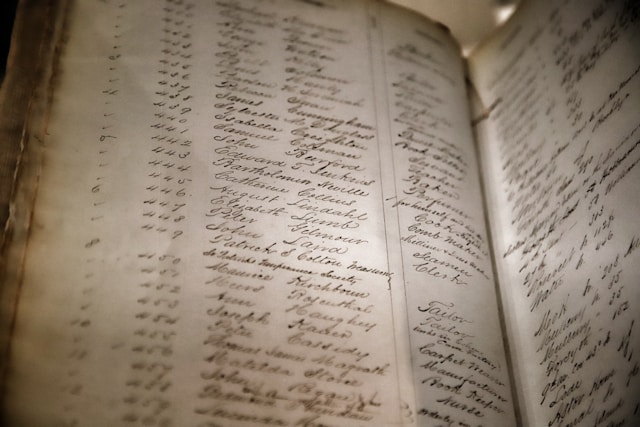
ADAC-GenealogyLibraries, archives, and family history researchers can use the ADAC-Genealogy profile to embed structured source citations, person annotations, and GPS evidence analysis directly into digitized census pages, vital records, church registers, and immigration manifests.
- Per-region person annotations with Genealogical Proof Standard evidence classification
- AI-assisted transcriptions with confidence scores and damage condition assessments
- Multi-page record linking and GEDCOM / FamilySearch cross-references

Legal Document Management
ADAC-LegalLaw firms, courts, and compliance teams can use the ADAC-Legal profile to embed case references, Bates numbering, chain-of-custody records, and per-region redaction metadata directly into exhibits, pleadings, contracts, and depositions — with jurisdiction profiles for US, UK, Louisiana, Puerto Rico, and more.
- Bates numbering, exhibit annotations, and confidentiality levels
- Unbroken chain of custody from receipt through archival storage
- Redaction documentation with legal authority and litigation hold status
Production Asset Management
Film studios and production houses can use ADAC to bundle raw footage, audio tracks, edit decision lists, and metadata into single, verifiable containers for archive and handoff between departments.
- Chain of custody for sensitive footage
- Automated quality control integration
- Cross-platform compatibility

Proof of Concept
Working implementations demonstrating ADAC capabilities across different technology stacks.
CLI Tool
C# Reference
Command-line interface for creating, validating, and extracting ADAC containers — including fixity verification, manifest generation, and batch processing.
Web Validator
Browser-based
Client-side validation tool allowing users to verify ADAC containers without uploading files to servers.
Storage Adapter
Cloud Integration
Reference implementation showing ADAC integration with cloud storage providers and object storage systems.
Try the Web Validator
Validate an ADAC container directly in your browser — no upload, no server, fully client-side.
Ready to Implement ADAC?
Join organizations adopting the ADAC standard for their digital asset archival needs.
Subscribe to Updates
Get notified about specification updates and new implementations.